




Linen Tablecloth Nopal
Price range: $224.34 through $387.08
Nopal cactus linen tablecloth — exclusive La Bottega di Casa design inspired by the cacti of San Miguel de Allende and Sicily.
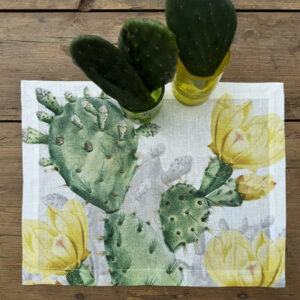
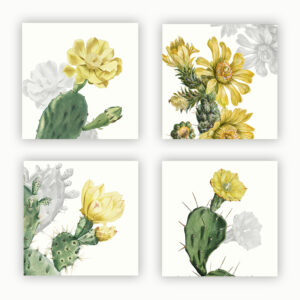
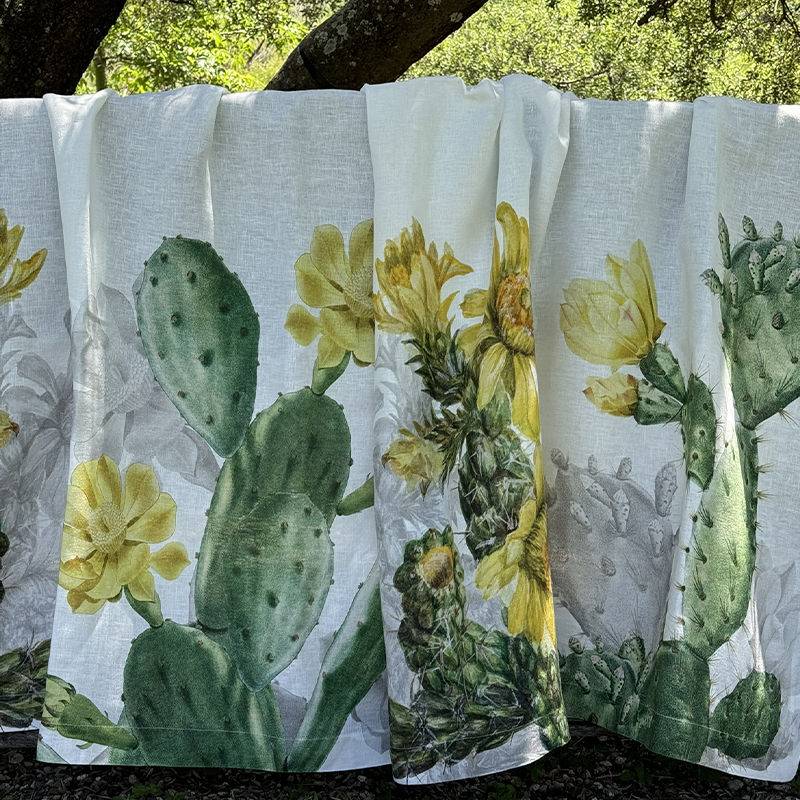
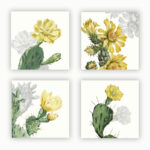
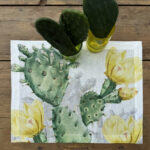
Botanical watercolour on natural linen: cacti in green and flowers in gold yellow, with grey sketches in the background. Every tablecloth is unique thanks to the continuous design. Hand-cut with mitered corners, atelier in Follina, Treviso. Custom size on request. Coordinated placemats and napkins also available. Made in Italy.
- Material: 100% natural linen
- Print: digital botanical watercolour on linen — exclusive La Bottega di Casa design
- Motif: allover nopal cactus in full-colour green and gold yellow, with grey botanical sketches in the background; natural linen ground
- Uniqueness: continuous design — every tablecloth has its own composition, no two pieces are identical
- Coordinated products: Nopal placemats and napkins also available
- Finish: mitered corners
- Craftsmanship: hand-cut, Made in Italy — atelier in Follina, Treviso
- Custom size tablecloth: almost any rectangular size on request, depending on fabric width availability
- Care: machine washable at 40°C (104°F), steam iron slightly damp, do not bleach
- Shipping: worldwide
- Brand: La Bottega di Casa

If you have been looking for a cactus linen tablecloth that feels genuinely botanical — not a decorative motif, but a precise and painterly rendering of a real plant — Nopal is what you are looking for. The design features the nopal cactus at large scale on a natural linen ground, mixing two visual registers: full-colour elements — the brilliant green of the pads, the gold yellow of the flowers — and grey pencil-sketch elements in the background. It is the technique of the botanical study: the finished plate and the preparatory drawing on the same page, as if the artist had left the process visible.
The result is a design of great visual richness that does not overwhelm: natural linen ground emerges in wide open areas between the forms, and the grey-sketched cacti create depth without saturating the colour. It is a design that holds up to close inspection — the petals, the spines, the texture of the pads are all rendered with botanical precision — and to distance, where the design becomes a bold graphic gesture of green and yellow on white.
The Nopal design is an exclusive La Bottega di Casa creation.
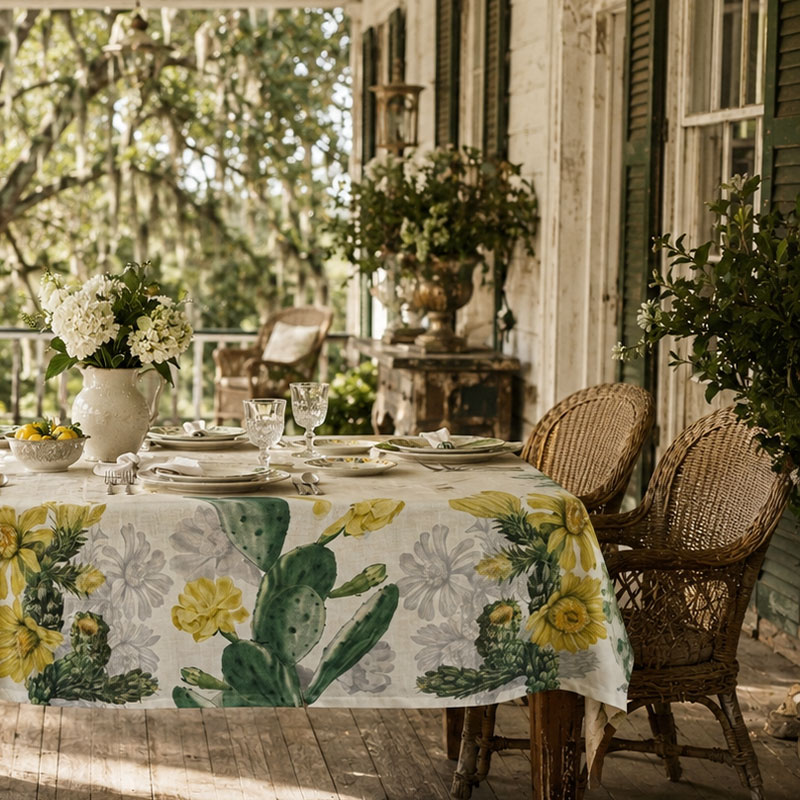
Because the design is continuous and non-modular, every tablecloth is different from the next: the starting point of the cut in the fabric and the dimensions of the tablecloth determine which elements of the design appear on the table surface and which fall over the sides. A smaller tablecloth will show a close-up view of the cactus; a larger one will distribute more specimens across the whole surface. No two Nopal tablecloths are identical.
As with all natural linen products, small fibre irregularities may be visible — slubs, weave variations, slight differences in thread thickness. These are not flaws: they are the signature of natural fabric, and part of what gives the cloth its character.
If you have been wondering where a design this specific comes from — La Bottega di Casa has an answer, and it begins with geography. Our atelier is in Follina, in the Veneto — but since 2000 we have also been in San Miguel de Allende, in the Mexican state of Guanajuato, where the nopal cactus is part of the landscape, the culture, and the table. Nopal grows everywhere in San Miguel: along adobe walls, in colonial courtyards, across the countryside surrounding the city. It is simultaneously a wild plant and a cultivated one, a decorative element and a kitchen ingredient, a symbol of Mexican identity and an everyday presence.
The Nopal tablecloth is a tribute to Mexico — to the colour and vitality of San Miguel de Allende — brought onto an Italian fabric, cut and finished in the Veneto, with the sartorial care that is the signature of La Bottega di Casa. A piece that belongs to two places at once.
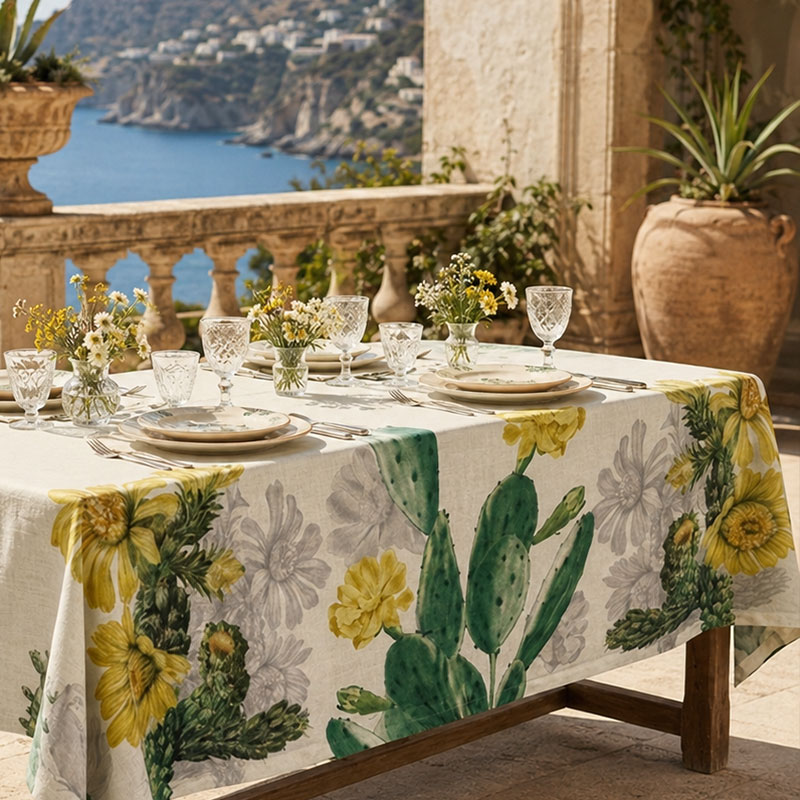
But there is a second chapter: the same prickly pear cactus grows in Sicily, where it is so deeply embedded in the landscape that it seems native. Stone terraces overlooking the sea, limestone, the white light of the Mediterranean — as seen in the third image — are a context in which the design feels equally at home.
And there is a third: the American Southwest. The landscape around Santa Fe, New Mexico — adobe walls, high desert light, the same nopal cactus growing against the same kind of bleached stone — shares something essential with both San Miguel and Sicily. For those with homes in New Mexico, Arizona, or anywhere the Southwest aesthetic shapes interior design choices, the Nopal tablecloth will feel immediately familiar: the colours are the same, the plant is the same, and the ease of the design in those interiors is natural rather than acquired.
Between San Miguel de Allende, Taormina, and Santa Fe, the Nopal tablecloth crosses latitudes without losing its identity.
Three images, three completely different contexts — and in all three, Nopal works.
In the first, a mossy Southern American veranda with wicker chairs, a white jug of hydrangeas, and a bowl of lemons: the yellow and green of the cactus converse with the green of the shutters and the yellow of the lemons in an instinctive chromatic coordination. It is also a reminder that the Nopal belongs in the refined homes of the American South and Southwest — on a porch in Louisiana, in a dining room in Santa Fe, on a terrace in Charleston — with the same ease it brings to a Mexican courtyard or a Sicilian sea view.
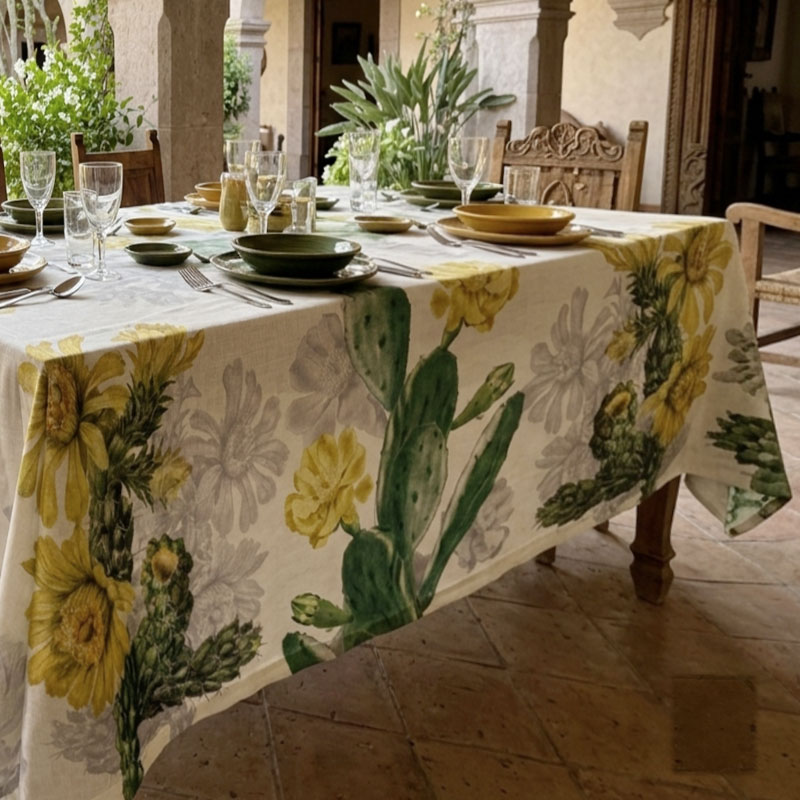
In the second, a colonial courtyard in San Miguel de Allende — stone arches, terracotta tiles, dark carved wood chairs, green and ochre ceramic plates. This is the setting the design was conceived for, and it shows: Nopal here is completely at home, speaking the same architectural language as the potted plants, the volcanic stone, the raw wood.
In the third, a Sicilian terrace overlooking the sea — the same stone, the same strong light, terracotta urns planted with agaves. Crystal glasses, small posies of yellow wildflowers, stone plates. Nopal in Sicily is as convincing as in Mexico, because the plant is the same and the light is similar.
Because Nopal is a rare design: the cactus on a table textile exists in Mexican folk tradition but rarely in quality artisan linen. This is a botanical watercolour illustrated with precision and printed on Italian linen — not a generic decorative print, but a piece of design with a precise story and a precise place of origin.
Because every tablecloth is unique — the continuous design guarantees no two are identical.
Because every piece is hand-cut and finished with mitered corners in our atelier in Follina (Treviso). And because this design carries two geographies in one cloth: order Nopal and you bring both a piece of San Miguel de Allende and a piece of Sicily to your table.
The rule with Nopal is the same as with all rich designs: solid colour is the best companion. The gold yellow and green of the cactus find their ideal partners in natural linen napkins, in olive green, or in ochre yellow. Green ceramic plates or natural stoneware — as in the San Miguel photograph — balance the design without diminishing it. White ceramics are always a safe and elegant choice.
Avoid other printed textiles: Nopal does not need decorative competition. It is already a complete landscape.
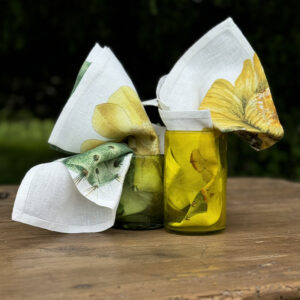
La Bottega di Casa also offers placemats and coordinated napkins in the Nopal design — the same botanical watercolour in reduced format, to complete the table setting coherently without repeating the tablecloth at full scale.
La Bottega di Casa is an Italian home linen atelier based in Follina (Treviso, Veneto).
Since 2000, a second store in San Miguel de Allende, Mexico, has brought the Italian linen tradition to one of the most beautiful towns in central Mexico. The Nopal design is born precisely from this meeting: the landscape of San Miguel, the artisan precision of Follina, a piece of fabric that belongs to both worlds.
La Bottega di Casa branded products are hand-cut and finished with mitered corners in our Italian atelier.
We ship worldwide.
Where does the Nopal design come from? The Nopal is inspired by the landscape of San Miguel de Allende, Mexico, where La Bottega di Casa has had a store since 2000. The prickly pear cactus grows everywhere in San Miguel — along walls, in colonial courtyards, across the countryside. The design is a tribute to this place and its vegetation. But the same cactus also grows in Sicily and throughout the American Southwest — around Santa Fe, across New Mexico and Arizona — which is why the tablecloth feels equally at home on a Sicilian terrace, in a refined Santa Fe interior, or on a Southern American porch. Three geographies, one plant, one cloth.
Why is every tablecloth different from the next? The design is continuous — it does not repeat on a fixed module. The starting point of the cut in the fabric and the dimensions of the tablecloth determine which elements of the design appear on the table surface and which fall over the sides. No two Nopal tablecloths are identical: the composition you receive depends on where in the fabric roll your specific piece begins.
What should I pair with the Nopal tablecloth? Solid colours. The yellow and green of the design find their ideal companions in natural linen napkins, in olive green, or in ochre yellow. Green ceramic or natural stoneware plates are the most successful pairing. White ceramics are always a safe and elegant choice. Avoid other printed textiles: Nopal is already a complete visual landscape.
Do you offer coordinated placemats and napkins? Yes. La Bottega di Casa also offers placemats and napkins in the Nopal design — the same botanical watercolour motif in reduced format. The ideal solution to complete the table setting coherently without repeating the tablecloth at full scale.
Can I order a custom size? Yes. We make almost any rectangular size on request, depending on fabric width availability. Because the design is continuous, each size will produce its own unique composition — contact us with your table measurements and we will be happy to discuss what the design will look like in your specific format.
You may also like…